Plain Sight
Foreword
Distribution was never a given: examining AR from 2,700 miles outside Silicon Valley
Currently I’m in a pretty torpid season of life and coupled with chronic depression. When you find yourself in that set of circumstances you learn to find joy where you can. More and more consistently, I find that joy in listening to music when I drive through the country.
I’m lucky enough to have that within arms reach of where I live in Central Pennsylvania. In springtime, when the trees begin to leaf-out, the small mountains are covered in green foliage that often reflects the azure tinge of the sky, it’s a type of beauty I didn’t realize existed living here when I was younger. In August, the flash rainstorms leave this gorgeous mist rising out of the same mountains. Six weeks later, you’ll be treated to the awesome hues of gold, orange and red.
Trust me, there’s a lot of miles tracing these roads.
Combine this landscape with a soundtrack like Goodbye Yellow Brick Road, Elton John’s seminal 1973 album and I get about an hour-long respite from the chemical imbalance that dogs my daily life. My dad often joins me on these drives, he’s 42 years older than I am and he was alive when John released that album. The farmland busy with tractors, roll past and the AC kept the windows closed and us unbothered by what we might call the smells of a working farm. After listening to the haunting guitar solo of the title track, I wasn’t interested in the next song “The Song has No Title” so I tapped a button on the steering wheel and said calmly, “Play the album Houses of the Holy by Led Zeppelin.” Before the ripping guitar loop that begins “The Song Remains the Same” filled the car, my dad turned to me and asked “Wait, what do you want me to do?” not knowing the voice command would summon the album from Apple Music.
In 1973, when both of these albums were released my father would’ve never imagined being in a car driven by his child that didn’t run on gasoline, nor that just naming the album into the steering wheel would cause it to emit from the speakers. But in 2025, he was still a little confused.
We’re 2,700 miles from Silicon Valley on these drives. Closer still we’re perhaps an hour or so from anyone who could describe the purported benefits of blockchains or answer a question about AGI. Yet we drive past farms and stables, through ghost towns that hollowed out during my childhood, we’re not sitting in diners with rubes and hicks but people who are proud of the commonwealth’s history and in full agreement of it’s beauty. But we, our friends and neighbors in Pennsylvania face real problems: a jobs crisis, a stagnant labor force, rising inflation and unevenly distributed healthcare.
My father grows dahlias here (there’s one tattooed on my arm). He sells bouquets out of a little stand outside the house, but he’s often seen handing out free ones to nurses, school teachers and veterans. He doesn’t know that if I put a 3D printer in the basement, we could easily ask almost any AI chat agent to construct the perfect folding ramekin to carry these bouquets for a bumpy ride. Let alone within half an hour mass produce them have them ready to hand out with each arrangement. Instead we use washed out McDonald’s cups, clever and handy and they fit in a cupholder, but your flowers will fly into the dash if you hit a bump or make a sudden stop.
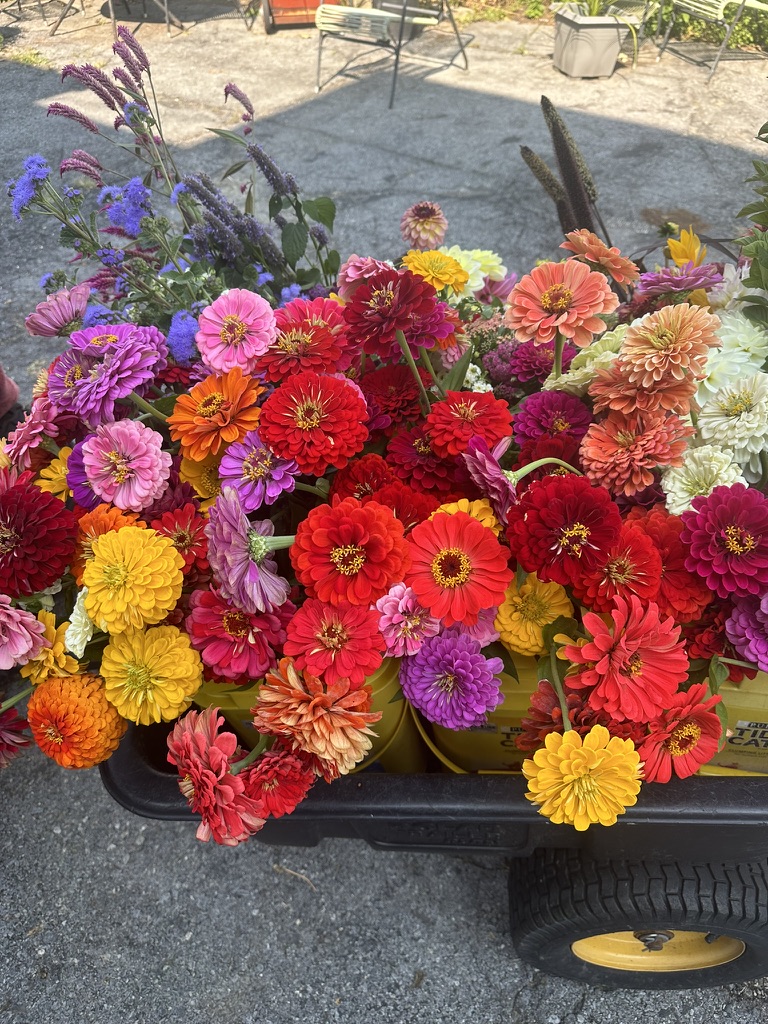
He doesn’t know that his Medicare benefits pay for a battery of telehealth solutions that could diagnose with dignity and privacy any number of the aches and maladies he grumbles through. I gave him a Mac Mini and a dual monitor setup and an iPhone, he finds it confusing to use voice mode or any of the number of accessibility features these devices offer let alone how to ask. However, he has been adept enough to figure out how to get his races to stream on one monitor and Facebook on the other (he was quite proud of that). He’s proudly shared some of my drone photography (a newer hobby of mine); some of the shots are of the sights and perspectives of this county and his friends remark about how they’ve lived here for the better part of a century and had never thought to look at their home from that perspective.
My therapist only recently discovered that her iPhone, with no additional application had the ability to convert all of her handwritten notes into selectable and searchable text. Years of notes and mountains of notebooks on patients that she could have indexed and searched and more easily recalled. She discovered this nearly 5 years since it was announced at WWDC and released 3 months later to every phone that could run iOS 15.
Drones, 3D printers, streaming, EVs, accessible tools in the phones and computers are around us and either aren’t clearly connected or discoverable. Technologists, futurists and engineers have too often quoted the line from William Gibson, the science fiction writer, “The future is already here – it’s just not very evenly distributed.” They’ve done this in the reckless pursuit of someone else’s vision of the future at the cost of their own agency and discovery of the tools that already exist.
Distribution was never a given.
For what it’s worth, we’re on the precipice of another big epoch shift with AR, augmented reality. It has the opportunity to fully enrich and integrate into the lives of its users and families. At the same time, it’s just as likely to turn every user into an unwilling participant in a dystopian surveillance state that pushes ads on endless lines of pseudo health-remedies in subscription deals.
As each wave of socially redefining technology comes we as a human collective are charmed by the novelty but just as it becomes cheaper and easier to obtain we’re chasing something else entirely. Software applications are now easier than ever to write, build and deploy. Hardware is becoming cheaper and smaller. But I don’t know what we’re going to build.
I’ve been working in tech for more than a decade and my second decade in this profession is stranger than the first. We’ve made our living building applications and software for both incredibly noble and incredibly asinine use cases. I’ve worked with some of the best developers and designers on the planet.
I could postulate or guess but there’s not enough Xanax on Earth to keep me from thinking that as technologists and developers that we’re more likely to build apps for smart glasses that will create AI-powered deepfake x-ray specs than we are to build applications for AR that enable us to connect with the people around us. We could build apps that turn everything in our field of vision into a masturbatory aid or we could build apps that show us a completely hidden world full of discovery and wonder. On my best days, I think we’ll at least do both.
Technology has the ability to make the lives of millions of people better not marginally better but substantively better. But these waves tend to make lives simply different and pseudo futuristic for those living in San Francisco and New York City. As someone who’s been writing code for more than a decade, there’s certain things I just don’t care about anymore. I don’t care about edge lords and incels on stream who can turn inanimate objects into waifus, I care about grandparents and aunties who can now be part of recitals and events without anyone having to wave a phone around. I don’t care about the next tech bro who can sleep through a meeting because their headset is on auto-record, I care about the overworked graduate student who can now replay lectures without anyone’s permission. I don’t care about what the next influencer who could now release a fully immersive “get ready with me” video, I care about that the next journalist can share stories with fully immersive videos of riots and protests.
Augmented reality has the Latin root word augmentāre, which means to make the present active to the infinite; to make better. Wearables are amazing, the Apple Watch has lived up a lot to its potential but most pendants and AI companions are jokes. AR can be different; it can be better.